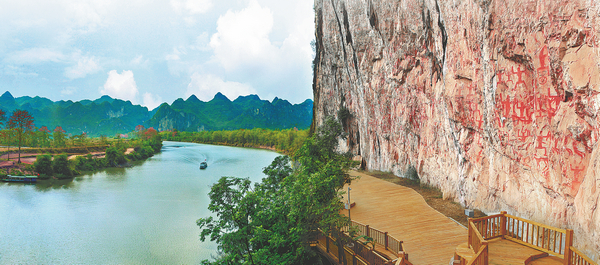
Huashan Rock Art
Introduction
The Huashan Rock Art, located on the east bank of the Mingjiang River, is part of the Zuojiang Huashan Rock Art Cultural Landscape. This remarkable cultural heritage site is situated within Guangxi Zhuang autonomous region, Southwest China. The rock art is an extensive collection of ancient paintings on limestone cliff faces, created over a span of several hundred years. The artworks primarily depict various aspects of the life and rituals of the Luoyue people, ancestors of the Zhuang ethnic group, who inhabited this region from the Warring States Period (475-221 BC) to the Eastern Han Dynasty (AD 25-220).
The paintings are found across three main areas: Ningming, Longzhou and Fusui, covering an area of around 6,621 hectares. The rock art was officially inscribed on the UNESCO World Cultural Heritage List on July 15, 2016, due to its cultural significance and historical value.
Historical Context
The Huashan Rock Art is believed to have been created by the Luoyue people, illustrating their daily life and ceremonial practices. The Luoyue were a group of people who once thrived in southern China, and the rock art provides significant insights into their culture and beliefs. The most prominent features of these paintings include depictions of squatting human figures, which are a common motif in prehistoric rock art worldwide. These figures are often associated with rituals and could signify worship or religious ceremonies conducted by the Luoyue.
One of the notable aspects of the Huashan Rock Art is its connection to the bronze drum culture, which was once widespread in this region. The bronze drums depicted in the paintings symbolize power and are still revered in southern China today.
Artistic Characteristics
The Huashan Rock Art comprises 38 sites, collectively containing approximately 4,050 painted images spread over an area of 8,000 square meters. The paintings include a diversity of subjects, such as humans, animals and tools. A typical scene often features a large male figure, distinguished by his half-crouching posture, arms raised, and weapons draped around his waist, surrounded by smaller figures similarly posed. These depictions are thought to represent sacrificial ceremonies central to the Luoyue culture.
The vibrant red pigment used in these paintings is a mixture of hematite powder and diluted animal fat, contributing to its durability over millennia. Despite being exposed to natural elements, the color remains vivid, a testament to the ingenuity of the ancient artists.
Cultural Significance
The Zuojiang Huashan Rock Art stands as a crucial cultural heritage site in China, representing the beliefs, customs and artistic expression of the Luoyue people. It is also a testament to the artistic prowess and the socio-religious dynamics of the communities that existed in this region over 2,000 years ago.
The rock art's lofty positioning, some as high as 130 meters above the river, remains a subject of study, with several theories proposed on how these ancient people managed such a feat without modern technology.
Additionally, the Huashan site is a place of spiritual significance for the local population. The cliffs are considered sacred, and local communities continue to conduct rituals and ceremonies to honor their ancestors and maintain a connection with their cultural heritage.
Preservation and Tourism
The Huashan Rock Art has been recognized for state protection as cultural relics since 1988 and later gained international recognition as a UNESCO World Heritage Site. This recognition has helped enhance conservation efforts, ensuring the continued preservation of these ancient artworks.
Visitors to Huashan can explore the rock art sites from specially designed vantage points and via boat tours on the Zuojiang River, offering an immersive experience of this extraordinary cultural landscape. The city museum of Chongzuo, located 46 kilometers from the cliff, provides further insights and detailed information about the rock art and Luoyue culture, enriching the visitor experience.
The Huashan Rock Art continues to captivate archaeologists, historians and tourists alike, offering a window into the distant past and the enduring legacy of the Luoyue people.








